
What is Implantology?
Benefits of dental implants:
- Aesthetic appearance: Implants are far more natural than prostheses and can be perfectly adapted to restore the appearance of natural teeth.
- Full function: The use of implants can restore the full function of the bite and can preserve the shape and function of the jaw.
- Comfort: They are durable and offer a long-term treatment option.
- Preservation of jaw bone: Following tooth loss, the jaw bone can begin to lose mass and volume, whereas the implant helps prevent this process.
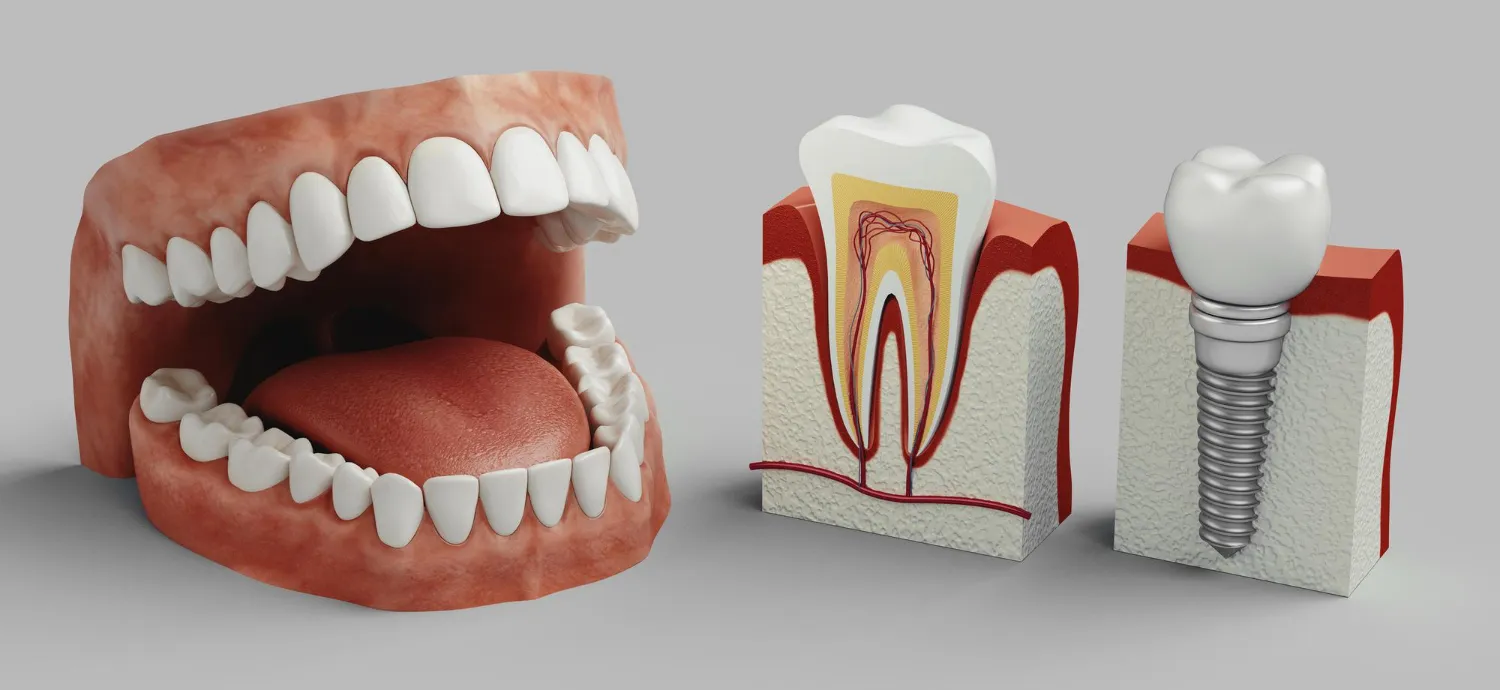
The dental implant placement procedure:
- Assessment and planning: Before any procedure, the dentist will carry out a full assessment of the condition of the mouth and jaw in order to establish the most appropriate plan. Images such as X-rays or computed tomography may be necessary to evaluate internal structures.
- Implant placement: The implantologist surgeon will carry out a surgical procedure to place the implant in the jaw bone. This is a safe process and is usually performed under local anaesthesia. After placement, the implant must heal and integrate with the bone over a period of several months, a process called “osseointegration.”
- Placement of restorations: After the healing period, the restoration (the new tooth, bridge, or prosthesis) can be placed over the implants, giving the patient a functional and aesthetic tooth.
Types of Dental Implants
The most common and widely used implants are endosteal implants, which are placed directly in the jaw bone. They are designed to follow the shape of the tooth root and are usually made from titanium or titanium alloy.
- Benefits:
- They are very durable and successful for the majority of patients.
- They provide support for a single tooth, a bridge, or a full prosthesis.
- They integrate well with the jaw bone for long-term osseointegration.
- Indications:
- Used for patients who have sufficient bone in the jaw to support the implants.
Subperiosteal implants are placed beneath the gum tissue, but above the jaw bone. This type of implant is used when the jaw bone is insufficient to support a traditional endosteal implant, or when the patient has experienced considerable bone loss.
- Benefits:
- Can be an option for those who do not have sufficient bone for an endosteal implant.
- Can be used to support full or partial prostheses.
- Indications:
- Patients with weak or lost bone, where bone grafting is not a suitable option.
Zygomatic implants are an option for patients who have severe bone loss in the upper jaw. They are longer than traditional implants and are placed in the malar bone (the cheekbone area or “zygomatic bone”), anchoring into a stronger part of the bone.
- Benefits:
- Suitable for patients who do not have sufficient bone in the upper jaw for traditional implants.
- An excellent solution for those who have undergone previous jaw surgery or experienced significant bone loss.
- Indications:
- Used when there is significant bone loss in the upper jaw and bone grafting is not a viable option.
This is a technique that uses 4 or 6 implants to support a full prosthesis. This technique is highly effective for patients who have lost all their teeth in one jaw and require a stable solution.
- Benefits:
- Very fast, as the patient can have a full fixed prosthesis on the same day as the surgery.
- Very well suited to those who have complete tooth loss and want a permanent solution.
- Indications:
- Patients who require a quick and stable restoration for the loss of all teeth in one jaw.
Mini implants are smaller than traditional implants and are typically used to support prostheses or as an option for patients who have weak bone or insufficient space for larger implants.
- Benefits:
- Less invasive and can be placed more quickly.
- Ideal for patients who have bone loss and require support for prostheses.
- Indications:
- Often used to support removable prostheses.
Immediate load implants are an option that can be placed and immediately loaded with a prosthesis (such as a new tooth or prosthesis), following the surgical procedure.
- Benefits:
- Can improve the aesthetics and function of the patient from the very first days following surgery.
- Ideal for patients who wish to avoid long waiting periods to receive their new tooth.
- Indications:
- Used in specific cases where the bone is strong enough to immediately support the load.
In some cases, implants may fail after placement, due to problems such as infections, failure of bone integration, or some other complication. In these cases, a second implant can be used to replace the failed implant.