What is Orthodontics?
Orthodontics is a field that deals with the alignment of teeth and jaw bones in order to correct disorders in their morphology and positioning. This treatment is often used to address aesthetic deficiencies as well as to improve oral function, such as chewing, speech and breathing. Orthodontists use various appliances to adjust and guide the teeth and jaws into correct positions, thereby contributing to the improvement of aesthetics and overall oral health.

Types of Orthodontic Disorders
Orthodontics treats a wide range of disorders that can occur with the position of the teeth and jaws. Some of the most common disorders are:
- Crowding: This is a disorder where the teeth are compressed and do not have enough space to settle into their natural positions.
- Spacing: When there is too much space between the teeth, often due to tooth loss or irregular bone development.
- Incorrect jaw relationship (Malocclusion):
- Class I: The upper and lower teeth are in a normal position, but there are other problems with alignment.
- Class II (Overbite): When the upper jaw is significantly more advanced than the lower jaw.
- Class III (Underbite): When the lower jaw is more advanced than the upper jaw.
- Open bite: When the upper and lower teeth do not touch each other when the mouth is closed.
- Crossbite: When one or more upper teeth are narrower than the corresponding lower teeth.
- Incorrect tooth alignment: This occurs when there is an unsuitable separation in the position of the upper and lower teeth that interferes with normal eating and chewing.
- Uneven gum line: Some individuals may have a gum line that is irregularly positioned or overly mobile, causing the teeth to shift or lose their positions.
Orthodontic Appliances
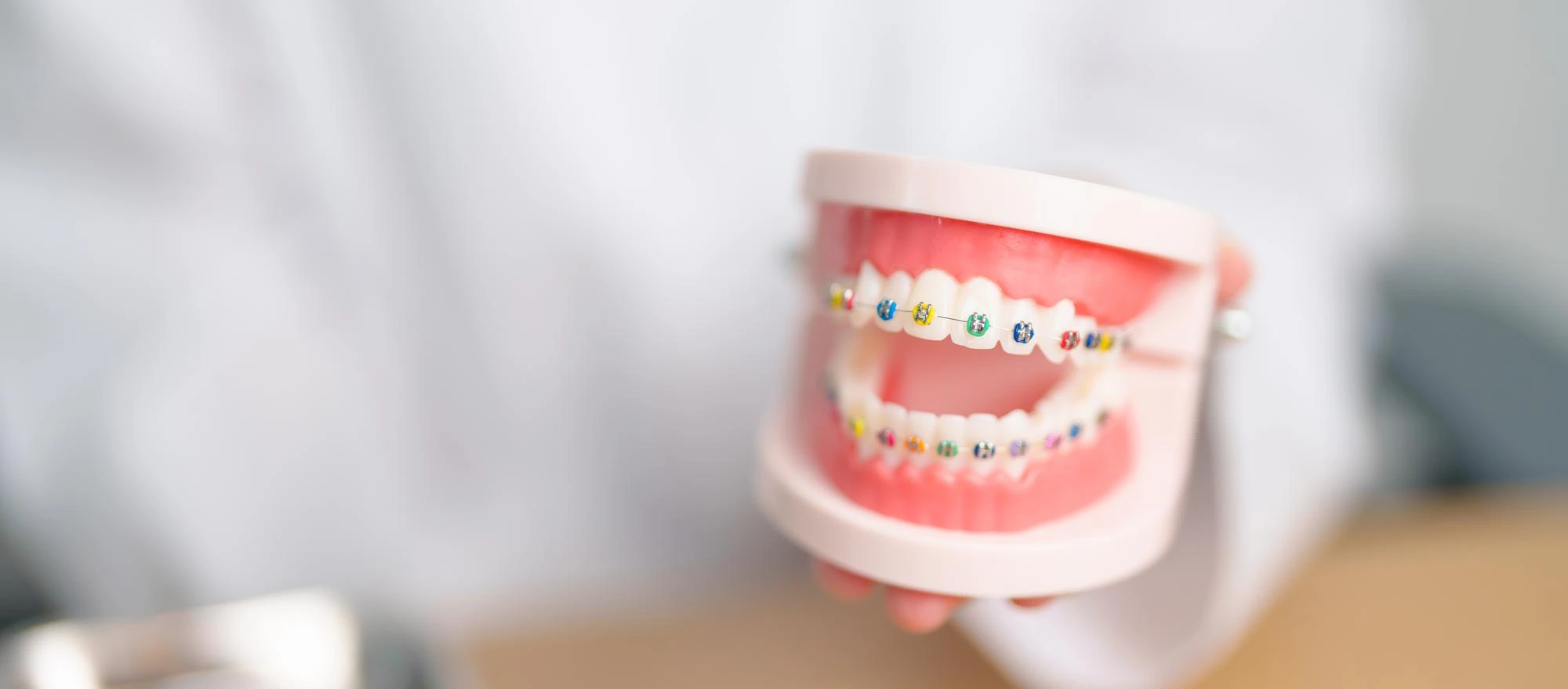
Braces are one of the most common orthodontic treatments and are used to correct the positions of the teeth. They consist of several key components:
- Metal brackets that are placed on each tooth.
- Wires that are connected to the brackets to apply pressure and move the teeth into correct positions.
- Elastics that are used to improve the alignment of the teeth and jaws.
- Other mechanisms (ligatures, hooks, etc.) that can be used to help achieve faster tooth alignment.
Braces can be metal, ceramic (less visible) or lingual, which are placed on the inner surface of the teeth and are invisible from the outside.
Invisalign is a modern alternative to traditional metal braces. This system uses a series of clear, flexible plastic aligners that mirror the shape of the teeth and gradually adjust them over time. Aligners can be removed for eating and brushing, and are more comfortable and aesthetically pleasing than traditional braces.
Used to increase the space in the upper jaw, correcting wide discrepancies and creating more room for teeth that are overcrowded.
After the completion of orthodontic treatment, in order to maintain the results achieved and to prevent the recurrence of disorders, the use of a retainer is usually required. This can be a transparent appliance or a system fixed behind the teeth, which helps maintain the new position of the teeth.